



Share





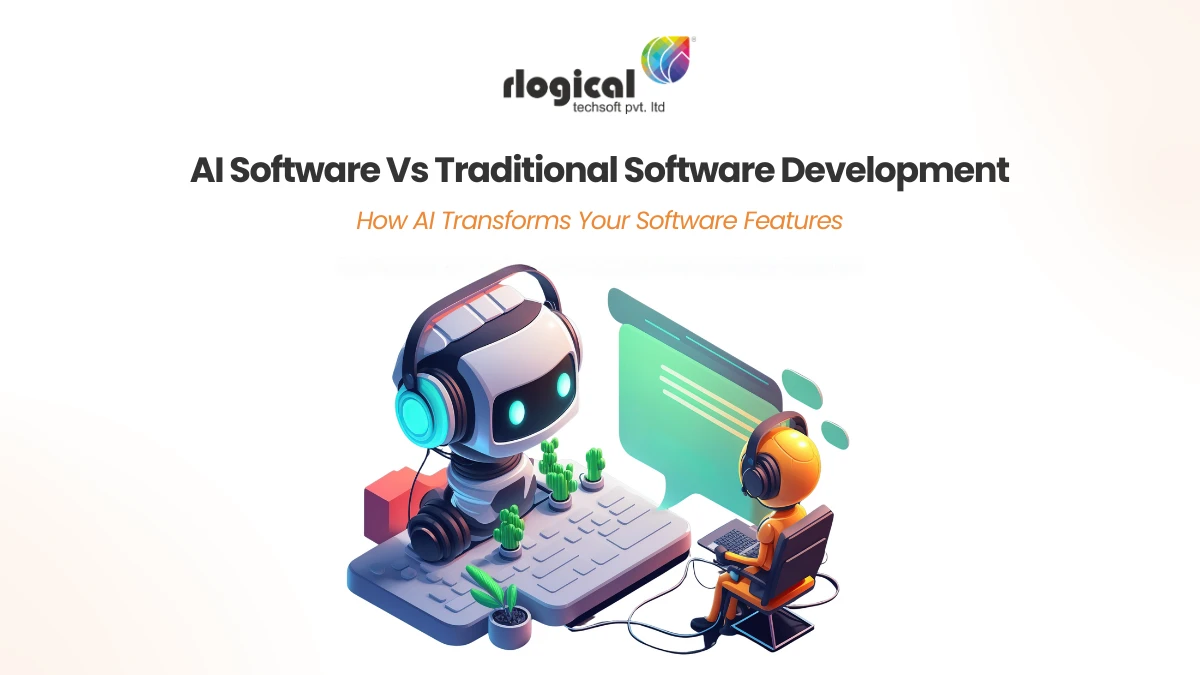
Quick Overview*: AI Software Vs Traditional Software Development… The most discussed topic among the business persons. Even for having the new solution or upgrading the present software, it demands detailed research and little information. This blog will provide you with insight into the difference between AI in software development and the traditional software creation lifecycle! Artificial intelligence is a transformative technology in software development, enabling new levels of automation, personalization, and efficiency. Artificial intelligence software, with its practical applications in personalized recommendations, AI-powered chatbots, and customized business solutions, will be a key focus of this article.*
The AI in software development has been widely reaching the market. It has efficiency and innovation at the intersecting point. You can leverage and enhance your process seamlessly. The best reason to have them is that they debunk the challenges of the traditional process. By implementing the AI software development services, you will gain a level of competitive edge. In contrast, conventional software is static and rule-based, performing predefined tasks without adapting or evolving over time. Defining both concepts to you and further representing the differential points.
This article will also explore the differences between AI and traditional approaches, comparing their design, adaptability, and roles in software development.
The AI-powered software development processes are a widespread solution today. AI technology is the foundation of modern software innovation, enabling systems to learn, adapt, and evolve. It is the new-age approach with advanced tools and technologies. The main motive of AI in software development is to improve productivity and innovation. AI systems benefit from continuous learning by adapting and improving over time. The optimized and automated workflows scale up to more accurate decision-making for your software.
During the development process, AI can eliminate the possible challenges usually faced in traditional methods. It’s an accurate and predictive analytics functionality. Such will harness the advantage of a faster and streamlined development process. This will work on AI models that gather relevant data and manage further tasks accordingly. AI models improve by incorporating new data, which helps them remain accurate and relevant as conditions change.
From code generation to testing, AI-powered software development replaces the manual rule-based methodology. Machine learning and pattern recognition enable AI to analyze complex data, identify patterns, and improve outcomes beyond what manual methods can achieve. You can enhance the efficiency and future-ready software solution for your project. In addition, AI can perform tasks that traditionally required human intervention, such as learning, reasoning, and decision-making. However, the emergence of AI doesn’t actually mean that traditional software development is dead. Unlike traditional software, AI adapts and evolves by learning from data rather than following fixed rules. It’s still there to have, but it should be combined with AI efficiency.
The all-time used sequential approach of software development commenced with a stage-wise manual. It works on enhancing your business with a digital and robust software solution to manage the operations. From the high-end software with market-led features to secure applications, all kinds of software solutions are managed under the traditional development cycle.
Moreover, it has choices among the different types of software development lifecycle methods. You can make the right solution for the business. With the top-notch software developers with hands-on expertise in different projects. However, developing AI solutions requires specialized knowledge and expertise to ensure effective implementation. However, the existing software should get the AI booster right away. Let’s have a better understanding of the comparative analysis between AI Software vs Traditional Software Development.
Here are the key differences between AI and traditional software development:
|
Factors |
Traditional Software Development |
AI-based Software Development |
| Workability | Works on pre-defined programming rules and relies on explicit rules and predefined rules for decision-making, making it more predictable when AI compared to traditional programming | Relies on the market-driven flexibility and adapts based on data rather than explicit instructions |
| Development Speed | Have a prolonged development stage, often working with structured data that is static and well-organized | Rapid app development process, handling more complex and unstructured datasets |
| Autonomy | Requires human intervention and depends on explicit rules for operations | Manages through an automated approach, adapting to new data without predefined rules |
| Modifications | Evaluate changes manually | Easily adapt to real-time changes |
| Complexity | Efficient for simple to intermediate-level projects, especially those with structured data and predictable requirements | Can easily handle sophisticated projects with complex, evolving datasets |
Traditional software projects and custom software development typically focus on smaller, structured datasets and predictable storage needs, resulting in lower ROI compared to the evolving, higher-yield nature of AI projects.
AI is fundamentally transforming business models by enabling organizations to adapt to changing market trends and operate in more innovative ways.
AI projects present unique challenges and a broader scope, requiring specialized development teams with interdisciplinary expertise to ensure success.
You have to follow the essential stages for building a successful software application. Conventional software is typically static and rule-based, performing predefined tasks without adapting or learning from data, which contrasts with the dynamic nature of AI. From new software or upgrading an existing solution, understanding the software development lifecycle (SDLC) is a major aspect. Applying software engineering principles throughout the SDLC ensures robust architecture, maintainability, and quality in traditional development. It will deliver a product that performs, scales, and resonates with end users. Here’s a step-by-step software development process.
Before writing a single line of code, it is compulsory to start with thorough market research. This initial phase helps define your target audience, analyze competitors, and even predict trends. Market research involves analyzing market trends and evaluating potential business models to ensure your product aligns with industry shifts and opportunities. During this process, collecting relevant data points is essential to inform your software roadmap and understand what your users need now and what they’ll expect ahead.
Next, the collaboration with the software development company to discuss the software’s core features, screen layout, and goals. At this stage, it is important to tailor requirements to the needs of a specific business, ensuring that the solution addresses unique challenges and objectives. Moreover, this also includes the development cost, tool selection, and project scope. It’s also the time to evaluate the risks and make the strategy accordingly. During requirement analysis, technical expertise and specialized knowledge are essential to accurately assess project feasibility and anticipate potential challenges.
With proper requirements in place, the design phase begins. It is essential to make an efficient wireframe of your software and then proceed with the programming stage. As the frontend and design are correlated, the design development will go in parallel.
Having skilled developers and UI/UX designers create workflows and architecture tailored to the software’s purpose is crucial. Effective design also relies on strong problem solving to address complex requirements and ensure robust solutions. Diverse development teams, combining various skill sets and backgrounds, are important for effective software creation and innovation. Moreover, this will process the whole software at staging to get it through quality checks. In traditional development, quality checks often require significant human effort to manually review and test the software. You can hire a dedicated development team that ensures alignment with user expectations and business objectives.
The next and crucial stage is testing. Before launch, rigorous testing ensures the software meets the functional and performance bar of the market. Having skilled QA engineers will validate your software features, identify bugs, and fix the errors beforehand. In data-driven projects, data scientists are often involved in validating data-driven features, ensuring that models and algorithms perform as expected. Therefore, this step is critical for delivering a reliable, user-ready software solution.
Once testing is complete, the software is deployed or made live. In such a way, it can be installed and configured by users. So, they can easily access your product and leverage the functionality. A successful deployment showcases the transition from development to real-world use.
In addition to that, the post-launch software requires ongoing support to stay relevant and updated with market dynamics. Well, the maintenance consists of security bug fixes, performance optimization, and many more aspects. Maintenance also involves routine tasks such as regular updates and system monitoring to ensure smooth operation. So, it will evolve your software to an even better solution. Refer to our AI ML development services guide further.
Next up, we have the whole steps for the AI-based software development procedure. Let’s dive into it.
The above traditional software development will remain intact in the AI software; it just gets a few additions of creating an AI model. For embracing AI in software development, you need an end-to-end process overview.
Beginning with the major stage of the AI model process. Even if you have described your AI software development goals, formatting them for a smooth process is inevitable. For example, you are targeting AI video search, so your overall AI software development should focus on it. Therefore, it precisely defines and structures your thoughts in the right direction for further steps. It is also essential to align AI development with your existing business processes and create tailored AI solutions for your specific ai projects.
Gathering relevant historical data is the key factor for custom AI model development. Your AI business application needs a historical database that is accurate and authentic. Using the effective data collection approach
The team ensures the quality of the data collected.
From the data collection to the validation stages and processing, the data is a valuable component for an AI model. High-quality training data and access to large datasets are crucial for building effective AI models, as they enable the system to learn and generalize accurately. Thus, it will analyze the data patterns and deliver predicted user behavior, which in turn helps to train the model.
Moving to the most important step, developing an AI model. Natural Language Processing (NLP) and Large Language Models (LLMs) are famous models for AI software development. Both can manage and process large amounts of data requests. However, your assistant needs to make the model selection and use relevant datasets. The data for training is tailored to your AI model’s core functionality.
AI algorithms are at the core of the ai system, enabling it to process data efficiently and deliver intelligent outcomes. The learning process involves extensive data processing and data analysis to uncover complex patterns, identify patterns, and leverage pattern recognition for improved model performance. Data scientists and development teams play a critical role in building, training, and validating AI models, ensuring the system meets business objectives.
Now comes the testing and quality assurance check, the non-negotiable stage. Your AI model needs to pass thorough testing on different scales. From performance to API testing, there is a vast array of QA types that your AI model should qualify through. Moreover, it identifies the error and resolves it. So, afterwards, you can deploy the AI model smoothly with utmost quality compliance. Deploying AI solutions requires extensive resources, specialized knowledge, and technical expertise to ensure robust and scalable implementation.
As your model was launched and enhanced for AI assistants, continue to analyze it. Monitoring the real-time performance and task completion of the AI solution. Because interaction with complex user queries gives an idea of your AI ML model’s efficiency. Additionally, you get the latest datasets to retrain the model. Therefore, it can align with the recent requirements and add refreshing data to model training. Continuous learning allows AI models to adapt over time, improving their performance and decision-making as new data becomes available. Ongoing evaluation also helps improve user interactions and supports automating repetitive tasks, freeing up human resources for higher-value work. Through this process, the model achieves more accurate predictions and delivers greater value to your business.
Moving into the industry usage comparison between AI software and traditional development methods. So, here you go…
Healthcare and medical app development stages can add to the AI tools’ efficiency without any hurdles. It eases the management and even helps in drug discovery and custom solutions. Therefore, your AI-based health firm enhances the scope of offering services to a wider audience. AI-powered health software brings advanced AI capabilities and AI solutions, enabling more accurate diagnostics, personalized treatment plans, and improved patient outcomes.
The traditional health software doesn’t offer remote services proficiently. It is restricted to the manual handling features and patient records management.
Education and e-learning institutes have performed tasks with predictive analytics. It primarily helps to create study materials and manage online classes with AI chatbots. AI is also transforming business models in education by enabling adaptive learning platforms, personalized content delivery, and new ways of engaging students.
Traditional education apps lack personalization functionality for students and tutors. Thus, it will not optimize the user experience and lag in speedy services.
For manufacturing and supply chain purposes, AI delivers high-quality control aspects. It also makes an impact by streamlining the workflow. Having a centralized platform, the AI-powered solution strengthens the overall productivity as well. Inventory management is a critical component in AI-powered manufacturing solutions, ensuring efficient resource allocation and reduced operational costs.
The manufacturing industry has been using a legacy system managing single and separate tasks. It increases the burden of managing different platforms; the AI approach will unify them in a single place. Integrating AI with legacy systems can be challenging, but scalable AI solutions help bridge the gap and modernize operations. So, it will enhance task management, and productivity will skyrocket.
From seamless online transaction management to fraud detection, the powerful AI models train the application. It enables your fintech app development to gain a deep learning algorithm. Thus, you can handle the app users’ needs way more efficiently. AI also improves user interactions in fintech apps by providing personalized financial advice, faster customer support, and adaptive interfaces.
The old-school software will have insufficient security measures. As data protection is a major aspect for the finance industry, transforming to AI is a must.
Rlogical Techsoft has been the first-choice AI development and consulting service provider in the USA. You can utilize the pre-vetted AI developers’ expertise for your project. The best part of having AI development is the budget. We offer a versatile and risk management solution at a startup’s budget. Book a call now!
The AI software development services will change as per the industry verticals and development integrations. Various factors affect the cost, like developers’ location and project complexity. You can hire an AI developer on an hourly basis at a starting rate of $25.
AI development will perceive the environment and process it according to the data patterns. On the other hand, traditional software needs the developers’ efforts end-to-end throughout the process. Therefore, the difference is about automation and accuracy.
Jatin Panchal is the Founder & Managing Director at Rlogical Techsoft Pvt. Ltd. For more than a decade, he has been fostering the organization's growth in the IT horizons. He has always bestowed personalized approaches on .NET, PHP, Flutter, and Full-Stack web development projects. From startups to large enterprises, he has empowered them to accomplish business goals. By delivering successful industry-driven solutions, he is encouraging the capability of AI, ML, blockchain, and IoT into custom websites and hybrid mobile applications.