



Share





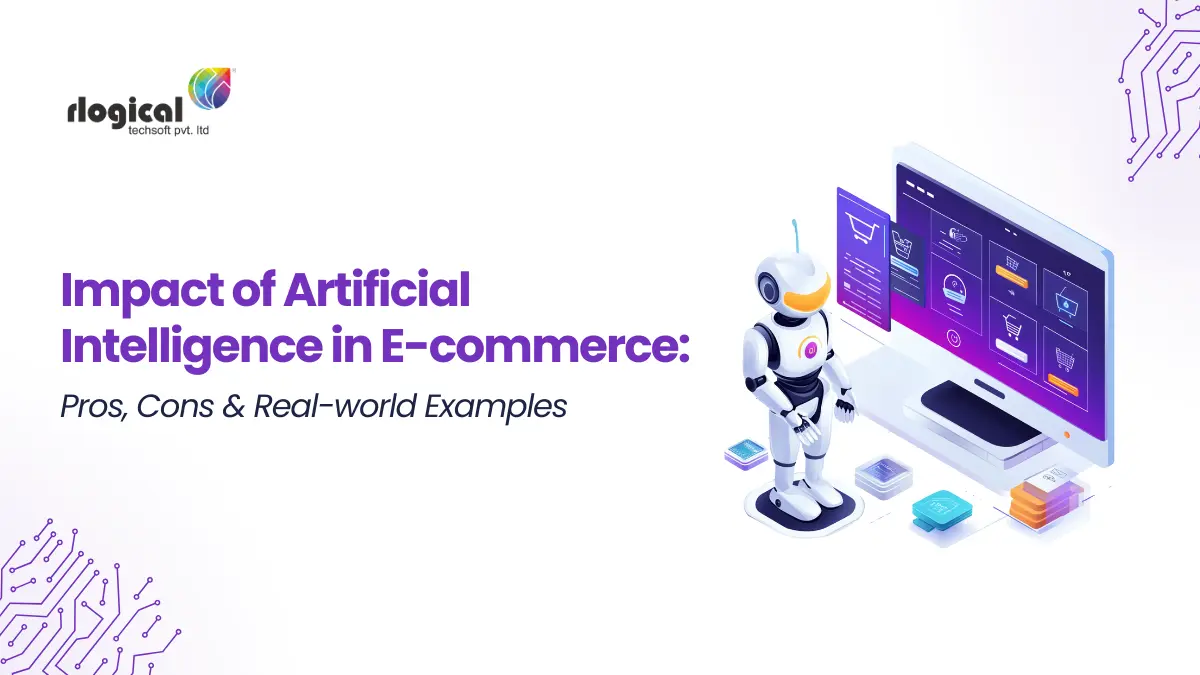
Quick Overview: The Artificial Intelligence in eCommerce industry has the potential to tap into the larger prospects. You should learn about this the right way to avoid the downfall later. There are a few Key Applications Of AI in e-commerce that have been among popular brands. Explore the blog to know how using AI in eCommerce will benefit in the upcoming years!
For Gen Z and millennials, the e-commerce stores and online shopping options are the best way out. AI is the additional glory in the search for high-potential e-commerce businesses. Features of AI are impressing teh audience and have higher conversion rates. It even transforms users with encrypted payment options.
The whole package of benefits of AI in e-commerce is something you can’t miss today. Have the AI in mobile app development from the right provider and deliver customized services. From searching for a specific product using voice dictation or image uploading to generative AI solutions, the AI area is vast in retail and e-commerce. Behold the details!
The eCommerce sector is a fast-moving industry with versatility. As the demand keeps shifting with emerging trends, e-commerce has to match the pace by adapting to them. The best way to align with the volatility of the marketplace is artificial intelligence (AI). In addition to that, there are future-proof benefits of AI in e-commerce.
The eCommerce app features get a touch of an AI model and machine learning algorithms. That means AI in eCommerce amplifies the features like;
In simple terms, artificial intelligence in eCommerce apps reduces the load time and offers user-centric navigation. Moreover, AI-driven features also lift the marketing aspect of the e-commerce app. Using complex models and historical data analysis, the eCommerce application delivers optimal customer interaction.
This is the most obvious and compelling benefit of using AI in e-commerce. It brings the excellence of custom AI solutions for your eCommerce application. From the traditional approaches of analyzing the customers’ behavior, AI switches to advanced demand pattern evaluation. Thanks to the AI/ML services, it processes the historical data and accordingly trains the model used in e-commerce.
The best part of offering personalized experiences is customer engagement. It directly increases the conversion rate and ROI of your business. Therefore, the role of AI in e-commerce eases the buyer’s journey and meets their individual needs with personalization.
The AI chat assistants and virtual customer support bots are already making great strides in the eCommerce sector. From limiting the need for humans to answer and interact with customers 24/7, AI chatbots are highly preferable today.
You can easily integrate and gain the edge of managing customer queries with preset auto-generated responses. So, the AI chatbots are blessing for your eCommerce store with enormous accessibility progress. Moreover, it restricts your need for manual efforts a result, save time and cost.
Inventory and warehouse aspects are completely automated by integrating the AI/ML tech solutions. It gets free from the manual efforts of bookkeeping and inventory inflow and outflow entries. The centralized AI-powered eCommerce app automates repetitive tasks. So, it helps in streamlining the workflow and even offers accurate sales prediction accordingly.
Similarly, the pricing aspect gets automated with AI in eCommerce apps. The AI revolution helps e-commerce firms define prices after evaluating the massive datasets. Further, it will help to plan or modify your pricing strategy. Hence, it enables your app to remain flexible and execute competitive price changes on a real-time basis.
The effective fraud detection or cybersecurity functionality is the ultimate need of businesses. AI in eCommerce comes out as a savior against data loss and cyberattacks. From safeguarding the payment gateways, customers’ details, and other business information, AI in eCommerce is the next big thing.
Having the use of AI in your e-commerce app to detect any suspicious activities and prevent data loss. Thus, it brings a higher value-added trust among your e-commerce users and restricts malware seamlessly. Next, we have a few limitations of AI in eCommerce; however, it’s primarily prone to the implementation part of AI.
Following the AI trend also brings some obstacles for the e-commerce app. So, listing here to prevent them with proper strategies.
The AI ML development services are about a hefty investment. As the AI ML programming is a sacred and revenue-driven solution, you have to plan a good funds to integrate it first. However, it can start with smaller amounts of creating an MVP. It can help in raising funds by gathering investors’ interest. So, you can tackle this hurdle with a strategic approach.
The data is the core of AI in eCommerce apps. You have to keep track of the accurate data collection and preprocessing. The malicious data will affect the whole process and become problematic in training the model. As a consequence, the workflow will get unorganized, and the risk of malware increases. Thus, the reliance on data needs to be watched vigilantly.
There is no one-time way of deployment-and-done concept in AI and ML. You have to measure the KPIs and make the adjustment ot the strategy or model training. With refreshing the datasets and churning the accurate ones, the process of AI in e-commerce apps is ongoing forever to retrain the model. You can get this point by knowing the big names. They have integrated and used AI in their business for so long now.
There are various key applications of AI in e-commerce. Here are the top names which has embarked on the success standards using AI.
These are just theTo keep ahead of the curve, you have to focus on artificial intelligence in eCommerce with future-ready trends. Get a glimpse of it.
Consumers seek out real-time experiences, which your website can provide with XR. You see, better conversion will result from increased customer engagement. Additionally, the development of the Apple Vision Pro has increased its significance and recent technological advantages. Many companies have incorporated VR and XR features. Therefore, you risk falling behind if you ignore it.
Particularly, if you want to target the iPhone app development market, Vision Pro support is required. It’s an innovative add-on in eCommerce to elevate the app performance. Your app to follow current trends because of the excitement surrounding Apple Vision Pro. Thus, you can create a seamless VR and XR experience with your application.
With tailored solutions, big data can help businesses grow more quickly. With this technological trend, you can access solutions for customer service and price optimization. Additionally, it provides countless opportunities for your eCommerce startup business to expand. So, it includes performance monitoring and competitor analysis.
Using AI in e-commerce has an encouraging future in the digital marketing field. From creating content like blog posts and social media posts, you can promote your brand. It has some of the hard-reaching targets like brand awareness and competitive edge.
Tools like ChatGPT, Copilot, and Canva are very good options to start with creating content, both textual and visual. Although you need a marketer’s intervention, as a small and instant start, you can use it. Later, having the expertise and resources will pave the way ahead.
AI ML development is the normal trend today, but the custom solutions have a broader edge. You need an outsourcing partner like Rlogical to transform the benefits of AI in your eCommerce app. All your queries are answered here, and our experts will prepare a complete wireframe for your project first. So, just get started with the quick discussion call now!
The cost to develop an AI e-commerce app is not certain and depends on your business needs. For your reference, it begins with $25 per hour. It’s when you hire AI developer from asian countries.
Rahul Panchal is the Founder & Managing Director at Rlogical Techsoft Pvt. Ltd. He is a pioneer tech enthusiast who has assisted diverse enterprise solutions with a fresh perspective over the years. From integrating technologies like Full-Stack, .NET, Flutter & PHP, he has harnessed custom web or hybrid mobile app development projects. His creative outlook on the latest models of AI, ML, blockchain, and IoT, has made various businesses attain leading-edge success.