



Share






Blog Overview: Looking for a one-stop custom web app development guide? You are on the right page. Its emerging demand has captured the attention of clients to develop web applications tailored to their business’s specific products. Custom web apps are indeed beneficial for any firm. As the web app resources provider, we have enough knowledge on how it works for you. Stay tuned to get useful insights!
For a world that is adapting to new approaches every now and then, custom web application development is the key requirement. Its global market size will reach $53.7 billion by 2029. Having your web and mobile app product driven with advanced features that outshine others is what businesses need. It has a combination of great technologies with the latest tool integrations.
As a custom web app development company, our team has hands-on experience in delivering such robust projects. To make it understandable to decide whether you should choose it or not, this article fits well. Beginning with the primary definition of custom web applications.
Custom web app development is the process of making extensive and personalized software solutions specific to your business needs. These are different from web apps in general. Because the intent for such web software development is exclusively driven by a particular business.
Usually, large-scale firms look to make their own custom software. It is mainly focused on strengthening its services and managing the business workflow smoothly. Also, it enables higher user engagement and boosts ROI. You will leverage below benefits of custom web application development to scale in the market smoothly.
To brush up your knowledge on this topic, here are the types you should also consider. It will allow you to pick the appropriate one based on your business.
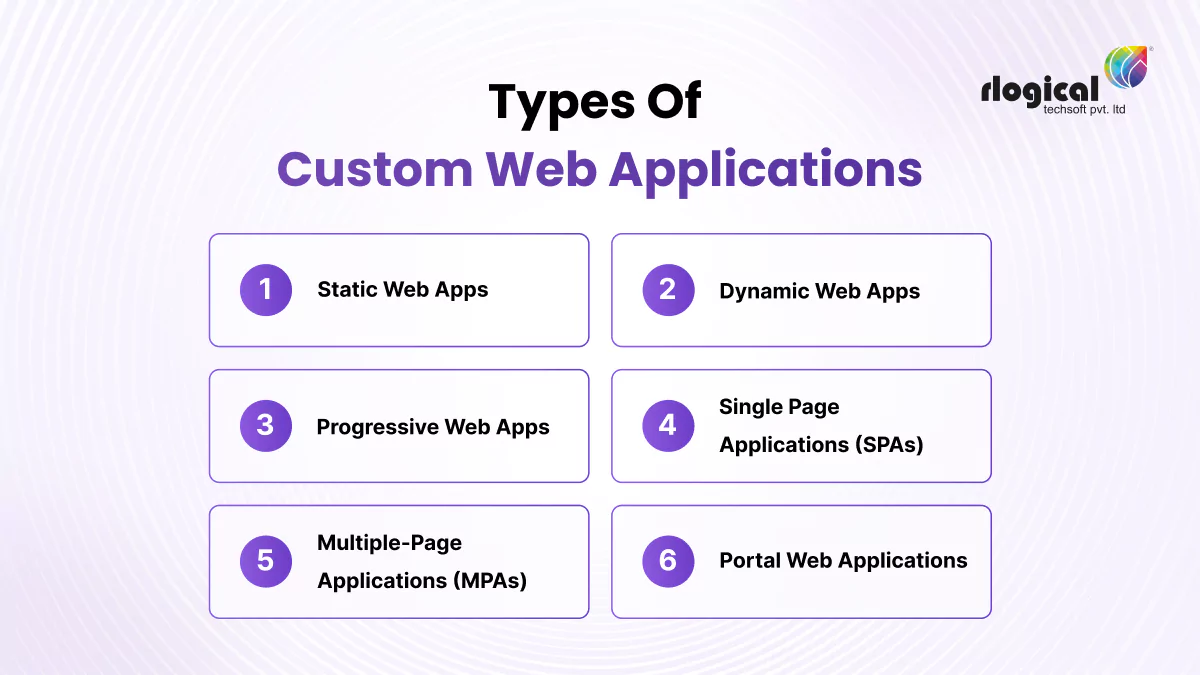
There are various types of custom web applications used by diverse industrial enterprises. This list will help you in deciding on the right kind of app for your business.
Static web applications are significant yet simple forms of custom web applications. It is used for building portfolios, resumes, brochures, and blog writing websites like Jekyll. These types of web apps are widely used for basic-level information-specific solutions. Moreover, static web applications have content that can’t be modified uniformly. Only the developers can access and change the content of static web apps.
Such web apps have a dynamic nature with versatile solutions for working and responding on a real-time basis. Dynamic web applications are based on having robust backend infrastructure and delivering data based on the current request.
Furthermore, dynamic web apps have highly compelling features like an interactive UI for better user engagement. Accordingly, dynamic web apps offer advanced solutions and give your business improved visibility. Facebook and Twitter are the most popular examples of dynamic custom web applications.
The progressive web apps (PWAs) are the current edge solution to deliver native and website accessibility. These application types are also recognized as cross-platform. However, it’s not the same app type. As a renowned web application development company, we have experts for any kind of application projects (basic to advanced).
Accordingly, as we have delivered PWAs, it come with a versatile strategy to let users access applications in offline mode. Thus, it has widened the scope of the audience due to the independence of the internet. By using the browser APIs, you can access the application smoothly. Some famous examples of progressive web applications are Starbucks, Uber, Forbes, etc.
Next comes the favorite web app type of small firms or startups. Single-page applications (SPAs) commonly opt for showcasing your business services on a single page. It is built to enable the loading of the page by rewriting or updating the web page with new data. Thus, rather than creating a new webpage.
Accordingly, the SPAs provide efficient user requests and responses by performing their interaction within the browser. Some of the prevalent single-page applications are Google Maps, Trello, and Gmail.
The multi-page application is an interesting type of custom web app development with contradictions for SPAs. It has separate developed pages to manage the request and response between the client and server. So, it has been an efficient solution for processing structured data with proper navigation among files. In simple terms, MPAs are applications that take users to another page while they click on specific links or icons. Amazon and eBay are widespread MPAs that represent the custom web app type.
Web applications are a sort of web-based platform that showcases the collection of information from relevant and accurate sources. These web app types operate on a single user interface to display data in a proper format and authentic manner. Wikipedia is a widely known instance of these custom web applications.
Usually, only the member users can access and modify the information of such web apps. Additionally, there is a wide range of industry portal apps you might have come across. Community portal, healthcare portal, eLearning portal, etc.
Now, the web app types are clear with relevant use cases. Let’s move ahead to the process of creating a custom web application.

The primary stages have been followed by web app developers to make leading-edge web applications. Just get along with this, and you will get a robust custom web application.
CTOs or entrepreneurs like you mainly do the very first stage of building a custom web app. It is all-inclusive, where the project’s objective, major research, and development requirements are determined. So, here’s what you need to do further.
Your application’s target audience is your end user, which you have to focus on priorly. By conducting the research and evaluating the right audience and their needs, you can make a project wireframe. It will allow you to enhance your custom web software development and handle the process smoothly.
As you look into the prevailing competitors in the market, you will explore how to enhance your project strategy. It will give enough insights into what your competitors are doing and gaining from the recent trends.
Based on the information collected from market analysis and rivals’ tactics, you have to frame realistic goals for your development process. So, it will help you at every stage to redefine the steps or tasks.
The second stage of custom web and mobile app development is the most fundamental one from the user’s perspective. You have to niche down the user interface (UI) components and other design needs. In addition to that, you will get to explore the bespoke web application development practice.
The user interface of your custom web application is the major aspect that grabs users’ attention. Having personalized and appealing UI components for applications is the key. You can further discuss partnering with UI/UX designers to make unique and future-ready design solutions.
Making your web app prototype with basic features and wireframing of web apps’ page navigation functions. This also helps in developing an MVP for the initial version launch to test your web app project. So, you can gain better benefits by making your business presence among users and attracting potential investors.
Before starting with actual development, you have to decide on the software development lifecycle (SDLC). It is also a prominent part of your development stages. There are popular SDLC models to choose from, such as Agile, Waterfall, Iterative, and so on. Based on that, your custom web app developer will put the server-side programming and client-side programming in the proper structure. Accordingly, the database management and API integrations will be processed further.
This stage is all about testing and verifying the performance metrics. Testing and quality assurance will help your project find and fix errors/ bugs efficiently. Only after thorough testing, your raw product is ready to launch for end users’ access. So, the steps below will help you in effective quality testing.
When you hire web app developer team, you can easily manage the various testing modules. As the team has experienced QA testers, your custom web app will be tested and evaluated by using various testing tools. Performance, testing, unit testing, API testing, security testing, and others are frequent QA services.
Take your web app to the next level with deployment on the platforms. It demands that you submit your web app files to the pre-opted operating systems. The developers have to pay attention to detail while performing the deployment task. However, the successful custom web application deployment will lead to optimized results in no time.
Lastly, the everlasting step of the custom web app journey for continuous, smooth performance. Maintaining the new trends and features keeps your user base engaged and increases. The version updates and revamping of the content and images make the web app more user-friendly. Such are the common ongoing tasks for retaining better results. So, it will let your app sustain itself in the ever-evolving competition.
Next comes the significant aspect of the custom web application development guide. Now, the list of accurate technologies used for your web app will enhance your project offerings.
The ultimate technology solution of custom web app product development majorly relies on the following.
Backend Development – PHP, Python, Express with NodeJS, Ruby on Rails
Frontend Development – HTML, CSS, JavaScript, React, VueJs, Angular, jQuery,
Testing Tools – SOAP UI, Appium, Cypress, Selenium JAVA, Maven
API Integrations – REST APIs, SOAP APIs, Map APIs, Payment APIs
Frameworks – Flutter, React Native, Ionic, Xamarin, Laravel, CodeIgniter
Database Tools – MongoDB, PostgreSQL, MySQL, Amazon DynamoDB
DevOps – Docker, Jenkins, Kubernetes, Git, AWS, Azure
You can connect with the dedicated development team to get better insights into technology needs. They will compile and personalize the backend and frontend based on your web app project. To expand with the latest technologies, here are the following forward-looking tech trends you should implement in your project.
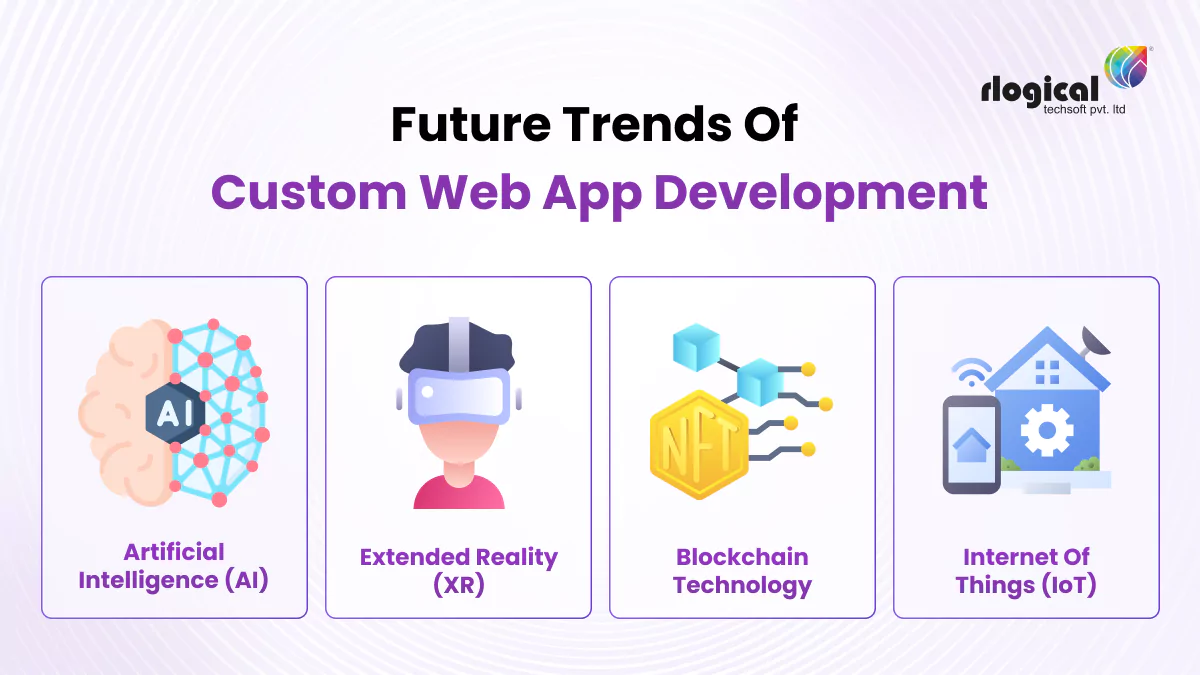
Artificial intelligence is becoming the primary aspect of custom web applications. It automates the functionality and delivers an enhanced user experience with personalized solutions. So, you can grab the attention of your targeted audience and deliver compelling outcomes with AI model analysis.
It is a sort of mixture of augmented reality and virtual reality that focuses on enhancing your product to interact with the customer’s needs. The introduction of Apple Vision Pro has boosted the XR solutions these days. You can also leverage its benefits for your business growth.
When you use the blockchain functionality in your web application development, it will give a decentralized network. Your business can manage the data seamlessly and securely with optional storage.
The features of IoT for your custom web app development strengthen your backend and increase the security patches. It detects any malware priorly to and protects the server from risks.
When you have finally made up your mind to develop a custom web application, you can begin by hiring our developers. As you collaborate with us, you will get started from scratch. Our team will provide you with an analysis of the market and your project scope and prepare the wireframe. So, you will get every aspect of your project with a unique strategy to make your project shine. You can schedule the first meeting with our team to get a demo of your application concept.
The precise reasons are as stated below;
Thus, it will unlock vast opportunities for your business to provide a more comprehensive solution.
The cost to build a custom web app ranges between $10,000 to $15,000 with primary factors aligning with your project. However, the advanced and complicated web applications with enhanced functionality raise this cost. So, it’s better to have a clear picture of your business idea.
The general web application is a software solution that works as a digital entity accessible through web browsers. It can be a service-based or product-based web app that operates on the predetermined platforms only.
On the other hand, the custom web app is a more tailored and exclusive solution focused only particular business need. Accordingly, the software will differ from the standardized guidelines of production as well.

Rahul Panchal is the Founder & Managing Director at Rlogical Techsoft Pvt. Ltd. He is a pioneer tech enthusiast who has assisted diverse enterprise solutions with a fresh perspective over the years. From integrating technologies like Full-Stack, .NET, Flutter & PHP, he has harnessed custom web or hybrid mobile app development projects. His creative outlook on the latest models of AI, ML, blockchain, and IoT, has made various businesses attain leading-edge success.